Bilkent University · Molecular Biology and Genetics

Decoding PI3K signalling in cancer

We study how individual PI3K isoforms, oncogenic mutations and PTEN loss rewire lipid signalling — and how tumours escape the drugs designed to stop them.

Research areas
3
Funded projects
7
Researchers
11
Publications
9

Research

What we work on

Three connected questions about how PI3K signalling is wired, how it breaks in cancer, and how tumours survive the drugs aimed at it.

02

PI3K Drug Resistance Mechanisms

Why tumours stop responding to PI3K inhibitors, and which combinations put the pressure back on.

Combination Therapy Drug Resistance PI3K Inhibitors Xenograft Models
03

PI3K-Regulated Cancer Cell Metabolism

How PTEN loss rewires lipid metabolism, and whether that rewiring can be targeted or read as a biomarker.

Cancer Metabolism Lipidomics Precision Medicine PTEN

The pathway

One cascade, four states

Follow the signal from the receptor to the nucleus — then switch on a hotspot mutation, delete PTEN, or add an inhibitor and watch what changes.

Interactive figure

PI3K / AKT / mTOR signalling

Scroll the figure sideways to follow the cascade.

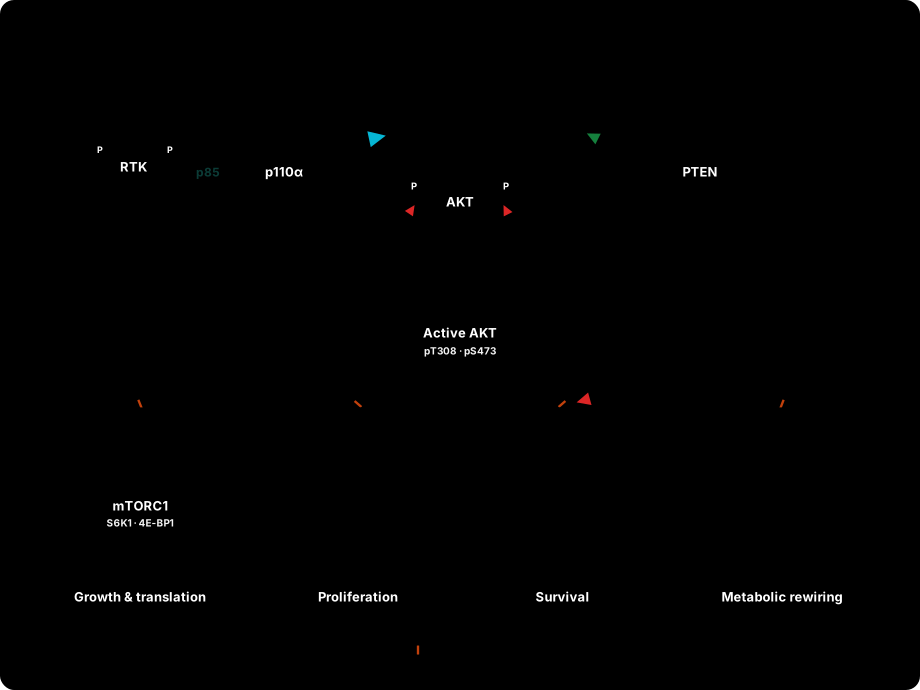
PI3K/AKT/mTOR signalling pathway An animated schematic. A growth factor activates a receptor tyrosine kinase at the plasma membrane. The p85–p110 PI3K heterodimer docks on the receptor and phosphorylates PIP2 to PIP3. PTEN reverses this reaction. PIP3 recruits AKT, which is phosphorylated at threonine 308 by PDK1 and at serine 473 by mTORC2. Active AKT then inhibits TSC1/2, GSK3-beta, BAD and FOXO, driving mTORC1-dependent growth, proliferation, survival and metabolic reprogramming. EXTRACELLULAR CYTOPLASM PLASMA MEMBRANE Growth factor RTK Receptor tyrosine kinase P P p85 p110α PI3K (class IA) H1047R ⊘ Alpelisib PIP₂ PIP₃ PTEN Tumour suppressor · PIP₃ → PIP₂ PTEN loss · PIP₃ accumulates PDK1 mTORC2 AKT P T308 P S473 Active AKT pT308 · pS473 ⊘ Capivasertib RESISTANCE BYPASS Isoform switching to p110β, RTK or JAK–STAT3 re-activation restores flux despite the inhibitor. TSC1/2 inhibited → RHEB-GTP ↑ GSK3β inhibited → Cyclin D1 ↑ BAD inhibited → apoptosis ↓ FOXO excluded from nucleus mTORC1 S6K1 · 4E-BP1 ⊘ Everolimus Cell-cycle entry Anti-apoptotic tone Nucleus Growth & translation Proliferation Survival Metabolic rewiring PIP₃ PIP₂ Phosphate activates inhibits clinical inhibitor tumour suppressor
Schematic drawn for teaching and outreach; not to scale.Download the figure (SVG)

Publications

Recent work

  1. Biotinylated Diaryl Isoxazole Derivatives with Enhanced Janus Kinase 1 Inhibitory, Antiproliferative, and Apoptotic Activities in Cancer Cells

    Erguven et al.

    ACS Omega · 2026

  2. PI3K Signaling at the Crossroads of Lipid Metabolism and Cancer

    Yilmaz & Cizmecioglu

    Advances in Experimental Medicine and Biology · 2025

  3. Molecular mechanisms of PI3K isoform dependence in embryonic growth

    Atıcı & Çizmecioğlu

    Journal of the Turkish-German Gynecological Association · 2024

  4. Class IA PI3K isoforms lead to differential signalling downstream of PKB/Akt

    Çatalak Yılmaz et al.

    Turkish Journal of Biochemistry · 2024

All publications

News

Latest from the lab

New publication in ACS Omega

Our work on biotinylated diaryl isoxazole derivatives with enhanced JAK1 inhibitory, antiproliferative and apoptotic activity is out in ACS Omega.

Student recruitment

Recruitment runs on a periodic basis; applications usually open in June and again in November.

All news and grants