Research

Research

Three connected questions about PI3K signalling, therapy resistance and cancer cell metabolism.

Our lab is dedicated to advancing the understanding of cancer biology and genetic disorders through interdisciplinary research. We focus on three primary areas of investigation, each aimed at uncovering the molecular and cellular mechanisms underlying disease progression, therapeutic resistance and potential treatment strategies. By integrating proteomics, lipidomics and functional genetics, we aim to contribute to precision medicine and personalised therapies.

Focus 01

PI3K Isoform Specificity and Oncogenic Mutations

Phosphoinositide 3-kinases (PI3Ks) are central regulators of cellular signalling, controlling cell survival, growth and metabolism. Each isoform has its own tissue distribution, functional role and regulatory mechanism. Our research asks what individual PI3K isoforms actually do, and how those roles change during cancer initiation and progression.

A major focus is the set of activating oncogenic mutations in the pathway that drive tumourigenesis across a wide range of cancers. By working out how these mutations promote uncontrolled proliferation and survival, we aim to identify isoform-selective therapeutic targets that could lead to more effective and less toxic treatment. The work also maps interactions between PI3K and other signalling pathways, which is where much of the complexity of tumour behaviour and therapy resistance lives.
Oncogenic Mutations PI3K Isoforms Signal Transduction Targeted Therapy
Focus 02

PI3K Drug Resistance Mechanisms

PI3K inhibitors have shown real promise as cancer therapies, but many tumours eventually develop resistance, which limits their long-term effectiveness. Our lab investigates the molecular mechanisms behind that resistance and looks for strategies to overcome it.

We use a combination of cell line models and xenografts to study the regulatory mechanisms involved. That includes identifying secondary mutations in PI3K and its downstream effectors, as well as alterations in other signalling routes that bypass PI3K inhibition altogether. We also test combination therapies aimed at those escape routes, including synergistic drug pairings that may restore inhibitor efficacy and improve patient response.

Combination Therapy Drug Resistance PI3K Inhibitors Xenograft Models
Focus 03

PI3K-Regulated Cancer Cell Metabolism

The tumour suppressor PTEN is the principal brake on the PI3K pathway. Loss of PTEN function, which is common across many cancers, dysregulates lipid signalling and leads to unchecked growth and survival. Our research focuses on the lipidomic changes that follow PTEN loss and how those alterations contribute to tumourigenesis and progression.

Using lipidomic profiling, we track specific changes in lipid metabolism — phosphoinositides, sphingolipids and other membrane-associated lipids — and ask how they affect key cellular processes. We are also testing whether those changes can serve as biomarkers for early diagnosis or prognosis. The work may reveal lipid-based and lipid-regulated targets for therapeutic intervention in PTEN-null cancers.

Cancer Metabolism Lipidomics Precision Medicine PTEN

The pathway

How the cascade fits together

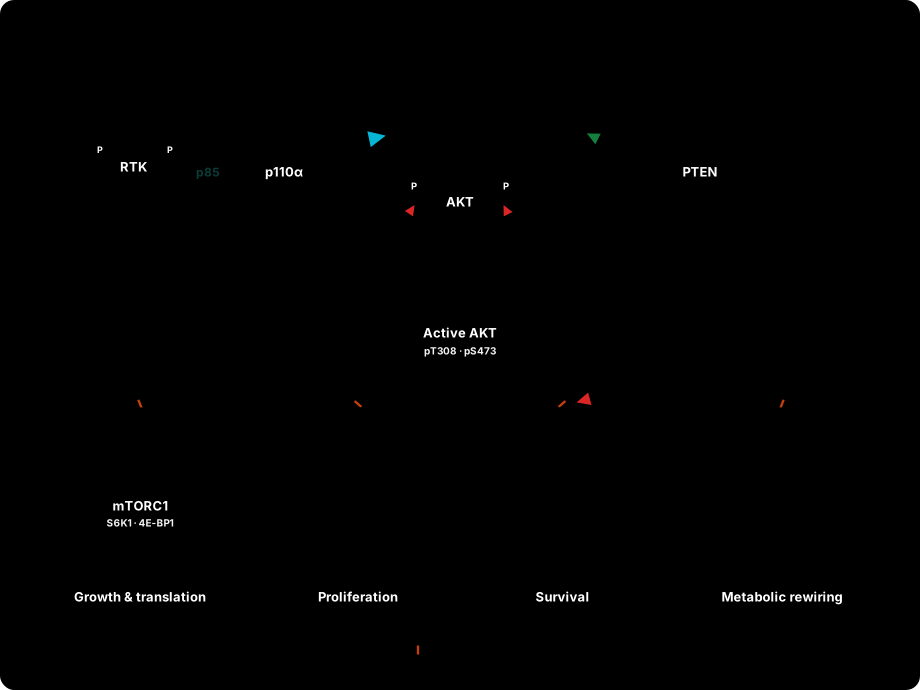
The same figure our three questions hang off: switch states to see a hotspot mutation, PTEN loss, or p110α inhibition.

Interactive figure

PI3K / AKT / mTOR signalling

Scroll the figure sideways to follow the cascade.

PI3K/AKT/mTOR signalling pathway An animated schematic. A growth factor activates a receptor tyrosine kinase at the plasma membrane. The p85–p110 PI3K heterodimer docks on the receptor and phosphorylates PIP2 to PIP3. PTEN reverses this reaction. PIP3 recruits AKT, which is phosphorylated at threonine 308 by PDK1 and at serine 473 by mTORC2. Active AKT then inhibits TSC1/2, GSK3-beta, BAD and FOXO, driving mTORC1-dependent growth, proliferation, survival and metabolic reprogramming. EXTRACELLULAR CYTOPLASM PLASMA MEMBRANE Growth factor RTK Receptor tyrosine kinase P P p85 p110α PI3K (class IA) H1047R ⊘ Alpelisib PIP₂ PIP₃ PTEN Tumour suppressor · PIP₃ → PIP₂ PTEN loss · PIP₃ accumulates PDK1 mTORC2 AKT P T308 P S473 Active AKT pT308 · pS473 ⊘ Capivasertib RESISTANCE BYPASS Isoform switching to p110β, RTK or JAK–STAT3 re-activation restores flux despite the inhibitor. TSC1/2 inhibited → RHEB-GTP ↑ GSK3β inhibited → Cyclin D1 ↑ BAD inhibited → apoptosis ↓ FOXO excluded from nucleus mTORC1 S6K1 · 4E-BP1 ⊘ Everolimus Cell-cycle entry Anti-apoptotic tone Nucleus Growth & translation Proliferation Survival Metabolic rewiring PIP₃ PIP₂ Phosphate activates inhibits clinical inhibitor tumour suppressor
Schematic drawn for teaching and outreach; not to scale.Download the figure (SVG)